Friday, January 04, 2008

Hope is the thing with feathers by Emily Dickinson

This week's poem is a hopeful one from Emily Dickinson to start off the New Year. Her voice, which I usually find ethereal and unsettling, is grounded here.


Hope is the thing with feathers

Hope is the thing with feathers
That perches in the soul,
And sings the tune without the words,
And never stops at all,

And sweetest in the gale is heard;
And sore must be the storm
That could abash the little bird
That kept so many warm.

I ’ve heard it in the chillest land,
And on the strangest sea;
Yet, never, in extremity,
It asked a crumb of me.


Emily Dickinson was born in Amherst, Massachusetts in 1830. She is known for her solitary lifestyle--she rarely left her house or hosted visitors. Along with Walt Whitman, she helped engender a uniquely American poetic voice. She died in 1886.

Friday, June 29, 2007

My Last Duchess by Robert Browning

This famous Robert Browning poem seems to plunk us down in the middle of a Victorian murder mystery, with Browning slowly unveiling the malevolence of his speaker. He wrote a lot of these dramatic monologues, influenced by verse playwrights like Shakespeare. I think his talent is most evident in his management of the poem's form: it's written as a series of iambic pentameter rhyming couplets, which is tough to pull off--you have to constantly disrupt the rhythm to keep the poem from getting maddeningly sing-songy.

Check out another good one here.


My Last Duchess

That's my last Duchess painted on the wall,
Looking as if she were alive. I call
That piece a wonder, now: Frà Pandolf's hands
Worked busily a day, and there she stands.
Will't please you sit and look at her? I said
"Frà Pandolf" by design, for never read
Strangers like you that pictured countenance,
The depth and passion of its earnest glance,
But to myself they turned (since none puts by
The curtain I have drawn for you, but I)
And seemed as they would ask me, if they durst,
How such a glance came there; so, not the first
Are you to turn and ask thus. Sir, 'twas not
Her husband's presence only, called that spot
Of joy into the Duchess' cheek: perhaps
Frà Pandolf chanced to say "Her mantle laps
Over my Lady's wrist too much," or "Paint
Must never hope to reproduce the faint
Half-flush that dies along her throat": such stuff
Was courtesy, she thought, and cause enough
For calling up that spot of joy. She had
A heart — how shall I say? — too soon made glad,
Too easily impressed; she liked whate'er
She looked on, and her looks went everywhere.
Sir, 'twas all one! My favour at her breast,
The dropping of the daylight in the West,
The bough of cherries some officious fool
Broke in the orchard for her, the white mule
She rode with round the terrace — all and each
Would draw from her alike the approving speech,
Or blush, at least. She thanked men, — good! but thanked
Somehow — I know not how — as if she ranked
My gift of a nine-hundred-years-old name
With anybody's gift. Who'd stoop to blame
This sort of trifling? Even had you skill
In speech — (which I have not) — to make your will
Quite clear to such an one, and say, "Just this
Or that in you disgusts me; here you miss,
Or there exceed the mark" — and if she let
Herself be lessoned so, nor plainly set
Her wits to yours, forsooth, and made excuse,
--E'en then would be some stooping, and I choose
Never to stoop. Oh sir, she smiled, no doubt,
Whene'er I passed her; but who passed without
Much the same smile? This grew; I gave commands;
Then all smiles stopped together. There she stands
As if alive. Will't please you rise? We'll meet
The company below, then. I repeat,
The Count your master's known munificence
Is ample warrant that no just pretence
Of mine for dowry will be disallowed;
Though his fair daughter's self, as I avowed
At starting, is my object. Nay, we'll go
Together down, sir. Notice Neptune, though,
Taming a sea-horse, thought a rarity,
Which Claus of Innsbruck cast in bronze for me.
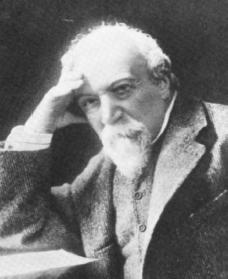

Robert Browning was born on May 7, 1812, in Camberwell, England. His mother was an accomplished pianist and a devout evangelical Christian. His father was a bank clerk and collector of rare books. After reading Elizabeth Barrett's Poems (1844) and corresponding with her for a few months, Browning met her in 1845. They were married in 1846, against the wishes of Barrett's father. He died in 1889.

Friday, June 27, 2008

Death Will Come and Will Have Your Eyes by Cesare Pavese

Cesare Pavese's "Death Will Come and Will Have Your Eyes" was among the poems found in his desk after his suicide. Considering the circumstances, it's strikingly haunting.


Death will come and will have your eyes—
this death that accompanies us
from morning till evening, unsleeping,
deaf, like an old remorse
or an absurd vice. Your eyes
will be a useless word,
a suppressed cry, a silence.
That’s what you see each morning
when alone with yourself you lean
toward the mirror. O precious hope,
that day we too will know
that you are life and you are nothingness.

Death has a look for everyone.
Death will come and will have your eyes.
It will be like renouncing a vice,
like seeing a dead face reappear in the mirror,
like listening to a lip that’s shut.
We’ll go down into the maelstrom mute.

--Translated by Geoffrey Brock


Cesare Pavese (1908-1950), a poet, novelist and critic, was a major Italian author of the 20th Century.

Tuesday, January 02, 2007

Boots of Spanish Leather by Bob Dylan

Yippee! I'm a poet, and I know it
Hope I don't blow it
Bob Dylan-- I Shall be Free. No. 10

He doesn't blow it. Dylan's song Boots of Spanish Leather not only works well as a poem, it boasts the rhythm, rhyme scheme, refrain and narrative movement of a traditional ballad, revealing some knowledge of the poetic form. Look at the similarities to the medieval Scottish ballad Sir Patrick Spence here (note: Sir Patrick sounds better if you read it with a gritty Scottish accent). Like much of Dylan's work, Boots of Spanish Leather is whimsical and emotional at once, and when the title image finally appears, it's both rewarding and suggestive.


Boots of Spanish Leather

Oh, I'm sailin' away my own true love,
I'm sailin' away in the morning.
Is there something I can send you from across the sea,
From the place that I'll be landing?

No, there's nothin' you can send me, my own true love,
There's nothin' I wish to be ownin'.
Just carry yourself back to me unspoiled,
From across that lonesome ocean.

Oh, but I just thought you might want something fine
Made of silver or of golden,
Either from the mountains of Madrid
Or from the coast of Barcelona.

Oh, but if I had the stars from the darkest night
And the diamonds from the deepest ocean,
I'd forsake them all for your sweet kiss,
For that's all I'm wishin' to be ownin'.

That I might be gone a long time
And it's only that I'm askin',
Is there something I can send you to remember me by,
To make your time more easy passin'.

Oh, how can, how can you ask me again,
It only brings me sorrow.
The same thing I want from you today,
I would want again tomorrow.

I got a letter on a lonesome day,
It was from her ship a-sailin',
Saying I don't know when I'll be comin' back again,
It depends on how I'm a-feelin'.

Well, if you, my love, must think that-a-way,
I'm sure your mind is roamin'.
I'm sure your heart is not with me,
But with the country to where you're goin'.

So take heed, take heed of the western wind,
Take heed of the stormy weather.
And yes, there's something you can send back to me,
Spanish boots of Spanish leather.


Bob Dylan, born Robert Allen Zimmerman on May 24, 1941, is an American singer-songwriter, author, musician and poet who has been a major figure in popular music for five decades.


You can listen to the song here.

Wednesday, October 25, 2006

The Day Lady Died by Frank O'Hara

In honor of my weekend trip to New York, here's a Frank O'Hara poem. It's an elegy for Billie Holiday which plays out how a moment of recognition and intense emotion can punctuate the everyday. Hope you enjoy.


The Day the Lady Died
By Frank O’Hara

It is 12:20 in New York a Friday
three days after Bastille Day, yes
it is 1959, and I go get a shoeshine
because I will get off the 4:19 in East Hampton
at 7:15 and then go straight to dinner
and I don't know the people who will feed me
I walk up the muggy street beginning to sun
and have a hamburger and a malted and buy
an ugly NEW WORLD WRITING to see what the poets
in Ghana are doing these days
I go on to the bank
and Miss Stillwagon (first name Linda I once heard)
doesn't even look up my balance for once in her life
and in the GOLDEN GRIFFIN I get a little Verlaine
for Patsy with drawings by Bonnard although I do
think of Hesiod, trans. Richmond Lattimore or
Brendan Behan's new play or Le Balcon or Les Nègres
of Genet, but I don't, I stick with Verlaine
after practically going to sleep with quandariness
and for Mike I just stroll into the PARK LANE
Liquor Store and ask for a bottle of Strega, and
then I go back where I came from to 6th Avenue
and the tobacconist in the Ziegfeld Theatere and
casually ask for a carton of Gauloises and a carton
of Picayunes, and a NEW YORK POST with her face on it
and I am sweating a lot by now and thinking of
leaning on the john door in the 5 SPOT
while she whispered a song along the keyboard
to Mal Waldron and everyone and I stopped breathing.


Frank O'Hara became one of the most distinguished members of the New York School of poets, which also included John Ashbery, James Schuyler, and Kenneth Koch. O'Hara's association with the painters Larry Rivers, Jackson Pollock, and Jasper Johns, also leaders of the New York School, became a source of inspiration for his highly original poetry. He attempted to produce with words the effects these artists had created on canvas.